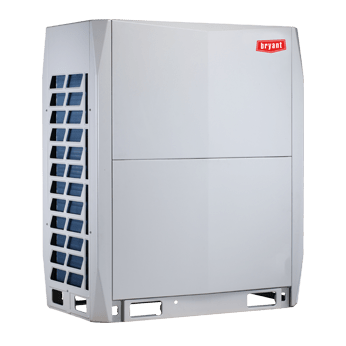
VRF outdoor unit

Back to Bryant products

Bryant 38VMH Heat Pump Outdoor Unit service and support

Bryant VRF and commercial HVAC VRF outdoor unit Repair, maintenance, and replacement planning
Bryant 38VMH Heat Pump Outdoor Unit product image

Product service snapshot

Bryant 38VMH Heat Pump Outdoor Unit service details

Type: 3-phase Heat Pump Capacity Range: 6.0 - 36.0 Tons Modules: Single, Dual or Triple

  • Brand: Bryant
  • Model or series: 38VMH Heat Pump Outdoor Unit
  • Equipment type: VRF outdoor unit
  • Product group: VRF and commercial HVAC

Technical snapshot

Bryant 38VMH Heat Pump Outdoor Unit technical snapshot

Product Specs

  • Available in 6, 8, 10, 12 ton single module which can be combined up to 36-tons capacity
  • Ability to connect up to 64 multiple style indoor units with a triple module outdoor unit
  • Piping flexibility up to 3280 ft
  • High performance outdoor units with all inverter-driven scroll compressor
  • DC inverter condenser fan motor
  • 208/230-3-60Hz or 460-3-60Hz voltage
  • Cooling ambient operating temperature is 14⁰ F to 122⁰ F and heating ambient operating temperature is -4⁰ F to 60⁰ F
  • Connected capacity is up to 135%
  • All equipment wiring complies with NEC requirements
  • Unit constructed in accordance with ETL requirements
  • Unit performance is in accordance with AHRI 1230 standards
  • Compressor and condenser fan motor are inverter driven
  • Brand: Bryant
  • Model or series: 38VMH Heat Pump Outdoor Unit
  • Equipment type: VRF outdoor unit
  • Product group: VRF and commercial HVAC
  • System role: Variable refrigerant flow system equipment
  • Application: Commercial, light-commercial, or managed-building HVAC and water-heating applications
  • Compatibility check: Match with compatible indoor unit, coil or air handler, controls, refrigerant, voltage, and capacity.
  • Verified source: bryant.com

Useful troubleshooting details

  • Confirm the packaged unit model, serial number, tonnage, voltage, refrigerant or fuel type, control setup, access location, and service history.
  • Share no-heat, no-cooling, weak airflow, alarms, control issues, tenant comfort complaints, condensate, or unusual noise.
  • For planning, include business hours, rooftop or mechanical access notes, tenant impact, replacement timing, and maintenance history.

Service planning

How GreenFlow handles 38VMH Heat Pump Outdoor Unit requests

1

Identify the equipment

Confirm the model or series name, serial number if available, photos, and whether the unit is roof, exterior, basement, or mechanical-room equipment.

2

Describe the service issue

Share no heat, no cooling, weak airflow, error codes, alarms, leaks, noise, control problems, or comfort complaints.

3

Review access and history

Include access notes, tenant or business-hour constraints, filter status, recent repairs, and maintenance records when available.

4

Plan the next step

GreenFlow can route the request for diagnostics, repair planning, maintenance, replacement scope, or related system upgrades.


38VMH Heat Pump Outdoor Unit service questions

Can GreenFlow help with Bryant 38VMH Heat Pump Outdoor Unit service requests?

Yes. GreenFlow can help collect the right details for Bryant 38VMH Heat Pump Outdoor Unit service requests, including the model, symptoms, equipment age, building type, access notes, photos, and timing.

What symptoms should I mention for 38VMH Heat Pump Outdoor Unit?

Helpful symptoms include no heat, no cooling, weak airflow, control issues, tenant comfort complaints, water-loop or condensate concerns where relevant, access constraints, and whether one space or multiple zones are affected.

Is 38VMH Heat Pump Outdoor Unit used for residential or commercial properties?

Commercial equipment requests usually come from offices, restaurants, retail spaces, mixed-use buildings, multifamily common areas, schools, and managed properties where access and occupied-space comfort matter.

What helps schedule 38VMH Heat Pump Outdoor Unit service faster?

Share the exact model and serial number if available, clear photos of the equipment and surrounding access area, current symptoms, recent maintenance history, and whether the request is repair, maintenance, or replacement planning.